Rhys Chatham: Meltdown!
Max's Kansas City, 1979
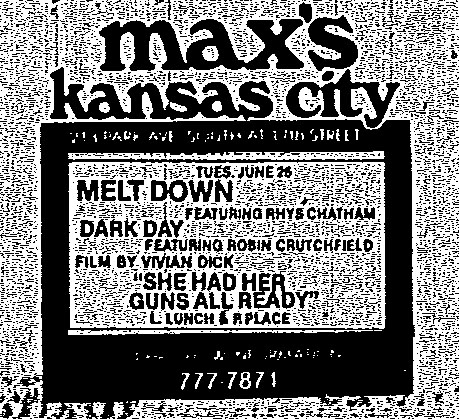
On a Tuesday evening in June of 1979, drummer David Linton and I were riffling through the listings in the back pages of The Village Voice looking for something to do. We had just moved to New York City intent on unleashing our band The Fluks (later: The Flucts) on the town. The Voice, along with the Soho Weekly News and smaller publications like the East Village Eye and New York Rocker, had chronicled the uprising of the punk era, and the following caught our eye: Meltdown at Max’s Kansas City. ‘Steve Reich meets The Ramones,’ said the Voice Choice. It had been only months since one of the worst nuclear reactor accidents on record had occurred at Three Mile Island near Harrisburg, Pennsylvania. It was big, scary news. “Meltdown featuring Rhys Chatham”. High noon in the nuclear era, and some band had called itself Meltdown!
David and I had yet to meet Rhys or Glenn Branca or any of the other downtown musicians with whom we would soon become closely involved, and who would help define the musical climate of the post New-Wave explosion in New York. The music which would evolve, via bands like DNA (with Arto Lindsay and Ikue Mori), Teenage Jesus and the Jerks (with Lydia Lunch), Branca’s Theoretical Girls (with Jeffrey Lohn) and The Static (with Barbara Ess), Mars, Ut, Red Transistor (with Rudolph Grey), Rhys’ own Arsenal and countless others which came and went, would define the ‘No-Wave’. These noiseicians reduced ‘rock’ to it’s most elemental state—a primitive beat and a forceful emotion. Rhythm. Volume. There were no ‘indie labels’ to speak of at the time, no real way for this music to pass beyond the shores of Manhattan, and therefore this music has never been given it’s proper due as the amazing, ground breaking stuff it was. Basically, if you weren’t there to experience it, you missed it.
The bands spawned a group of musicians who desired to reach further and more seriously as composers, using rock music as their source material. At the time Rhys Chatham, Glenn Branca, Jeffrey Lohn and others were working directly alongside more ‘serious’ composers like Reich and Phillip Glass in creating a popular, minimalist art music, often employing complex textures or massive volume.
My group with David—The Fluks—would soon play Max’s and CBGB’s ourselves and connect with a whole coterie of interesting younger musicians following in the immediate wake of the No-Wave, including, among others Thurston Moore’s band at the time, The Coachmen, who were playing the same circuit we were, trying to get noticed. Although at the time Max’s was past it’s heyday, when the Velvets and Warhol, artist Robert Rauschenberg, Iggy Pop and Janis Joplin could be found upstairs in it’s back room partying side by side—we were keen to hang out in it’s dingy ambience. ‘Meltdown’ sounded too good to pass up.
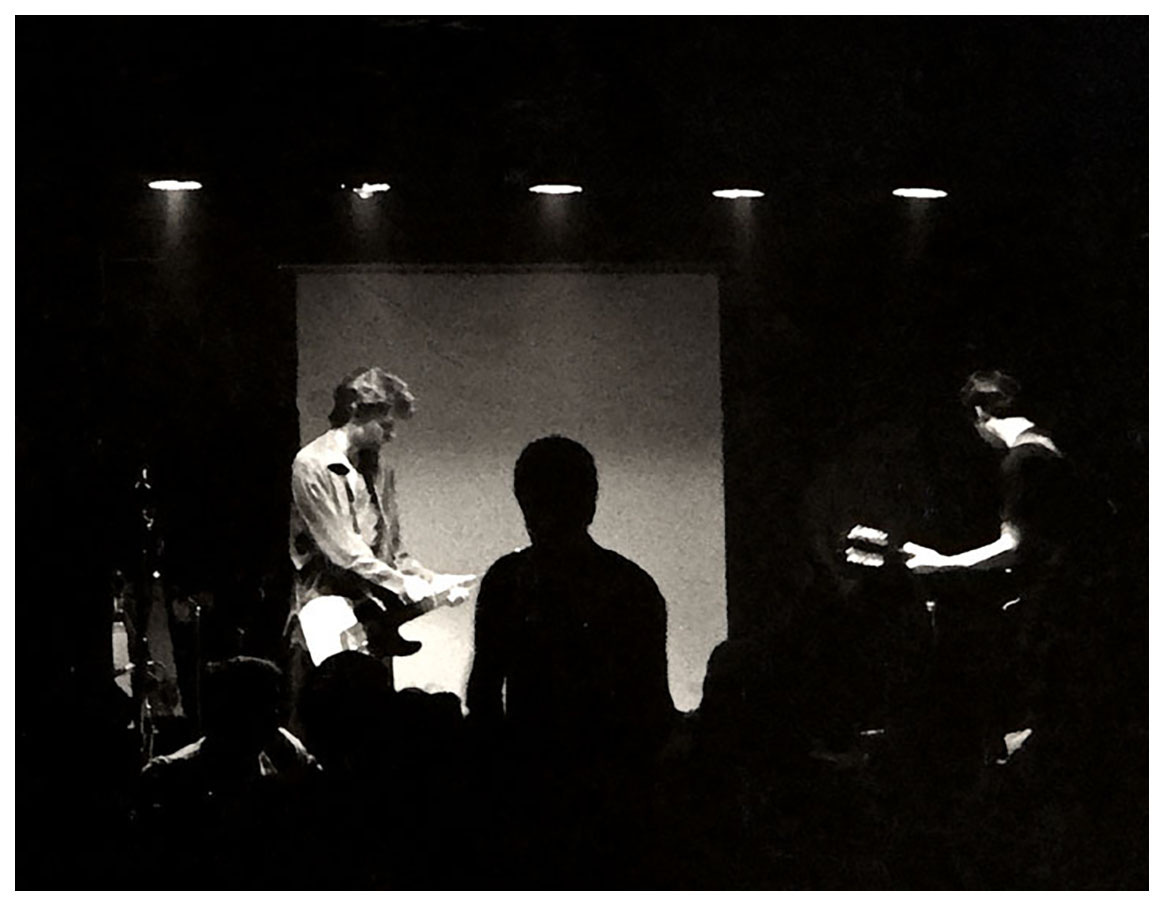
The curtains opened and three men with electric guitars stood in a row across the stage. Behind them, center stage, a ‘drummer’ stood erect with a lone high-hat cymbal. These were, we later discovered: on the right, clean cut guitarist David Rosenbloom, whose band Chinese Puzzle was part of the downtown art/rock scene. To his left was downtown stalwart Wharton Tiers, manning the hi-hat. Wharton was a member of A Band with Paul McMahon, and he’d played in Theoretical Girls as well with the guy prowling the shadows on the left—tattered army fatigue jacket collar upturned like a punk Elvis in a rags, holding his guitar like a weapon: Glenn Branca.
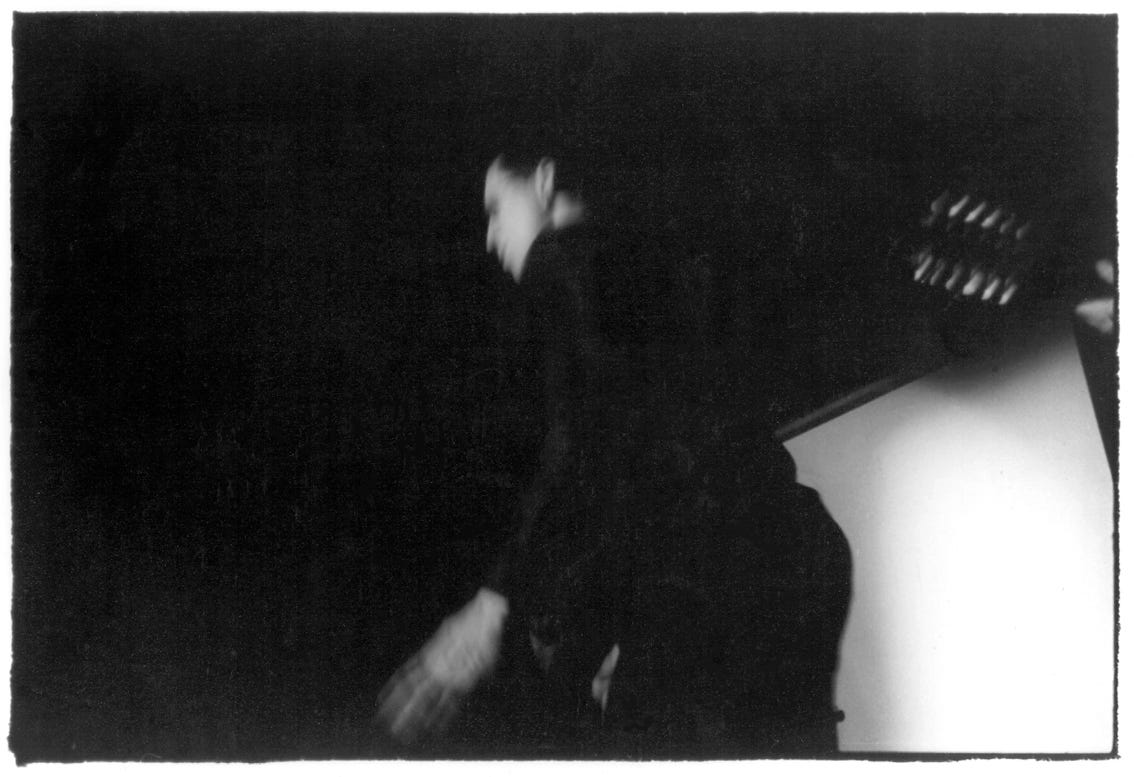
Rhys himself stood center stage. He had these weird Roger McGuinn-style granny sunglasses on his nose, leather vest, lips pursed, a determined look on his face, perhaps standing a little unsteadily. That is, until the music started. Rhys began stumming downstrokes on his low E string (we later found out it was a specific tuning of the guitars, not conventional EADGBE jive at all). Soon Glenn and David joined suit, one after the other, with Wharton beating out eighth notes on the hat. That was it for percussion—he was getting a lot out of opening and closing it for accent purposes. The sound grew as the guitars slowly introduced the other strings, each in succession, creating a complex chord. No one ever touched the fretboard once; just this open ringing de-tuned tuning that built to an incredible din (indeed The Din was the name of one of Rhys’ later ensembles). Occasionally Rhys would give the others cues for changes in section or intensity, his whole torso nodding the last 4 counts, his mouth miming ‘one, two, three, four…’
Something was going on inside the music that I couldn’t put my finger on. Although the players seemed to be simply downstroking with flat picks across the length of the strings, amazing things were happening in the sound field above our heads. Overtones danced all around the notes, getting more animated, turning into first gamelan orchestras, then later a choir of voices, and finally a complete maelstrom of crushing sonic complexity, ping ponging over the minimalist low notes of the rocking chord.
Rhys was definitely more than a little high (“I was on Quaaludes and speed that night, yikes!” he later told me). As the music reached full tilt he started weaving into the crowd, down the long narrow center aisle between the rows of tables running up to the stage. Beer glasses were rattling from the decibels. Seating was sort of communal along the rows, and as Rhys walked he began swinging his guitar absentmindedly, hitting people in the head and knocking over drinks and stuff. People scrambled to get out of his way, but he seemed so absorbed in the music that he didn’t notice the commotion at all. He slowly made it back up to the stage and the musicians dropped strings one after another until they were all back on just the low note, gamelans subsiding but still dancing, and then it was back to just Rhys for awhile, with that insistent rhythm on the low string. Finally, after what was about 25 or 30 minutes, but that felt like a glorious forever, he let the last note ring.
The crowd sat stunned at first, and then broke into wild applause! A roomful of people were amazed at what they’d just heard! After the applause died down, Rhys announced with an exuberant slur in his voice that the band was going to perform ‘another number’, which was a bit of a surprise considering that they had essentially played one chord for a full half hour! Rhys began drumming on the low string once more, and the group proceeded to careen right back into the exact same thing again, for another half-hour! THE SAME EXACT THING! Fantastic! At this point some of the ‘less committed’ in the audience ran for the exit!
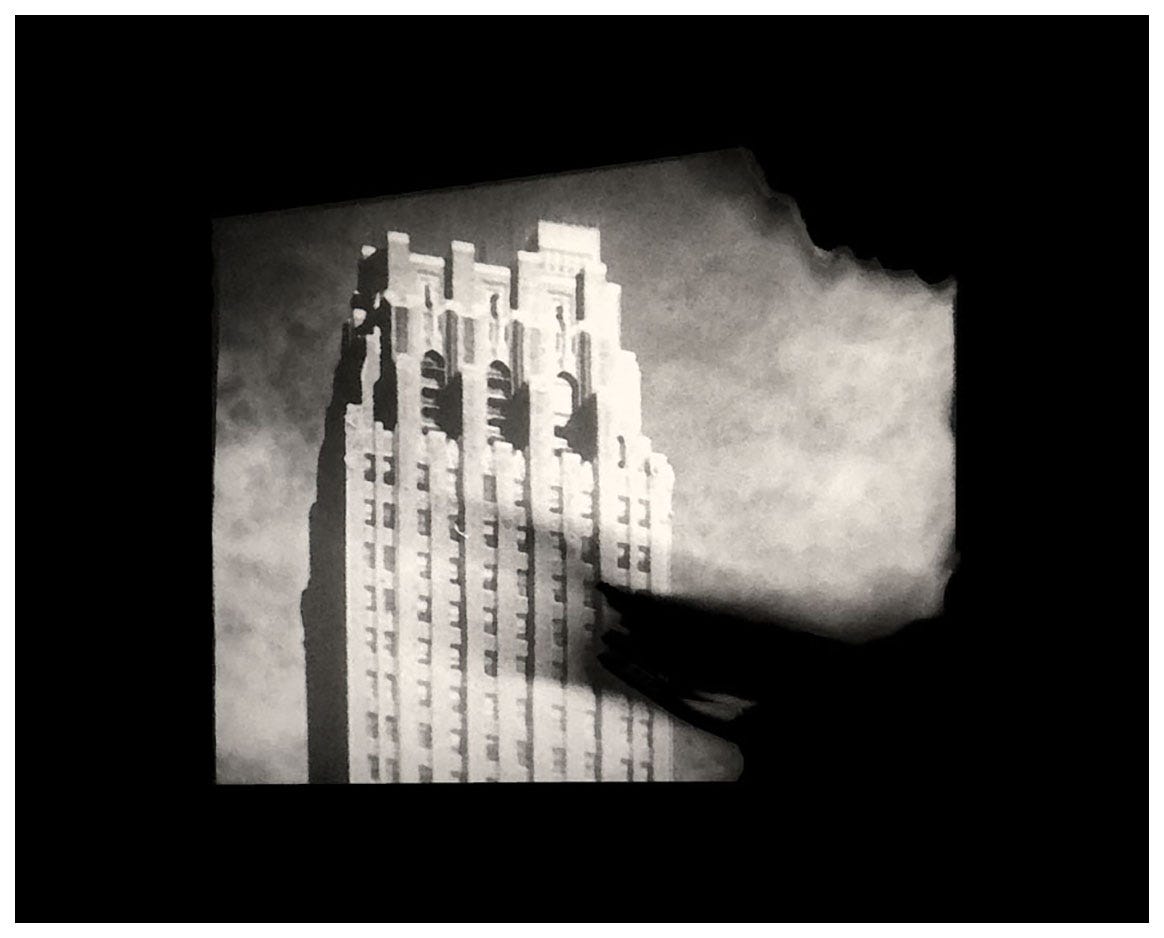
This second time, though, a series of grainy black-and-white slides of ambiguous, film-noir-ish scenes were projected on a screen behind the band. A famous shot of the old Pennsylvania Station with the huge beams of sunlight beaming down, a Pacific Island beach with low flying (Japanese?) fighter planes. The brilliant whites in all the images had a transcendental vibe that seemed to connect them to each other. One at a time an image would appear, long slow fade in then hold a long time then long slow fade out. There were only about 5 slides over the half-hour, moving in glacial time. Turns out these were the work of fellow musician and up and coming ‘art star’ Robert Longo, and their use during the second ‘half’ of the performance became an integral part of the piece.
I had some sort of ecstatic experience there, listening to this strange music and watching these images. I say strange because on the one hand it was upbeat, rocking out and familiar. But it had this other quality to it as well; something else was going on there. This was ‘Art’ too. The piece was Rhys Chatham’s Guitar Trio, and it was our entry into an amazing new world of music being created below 14th Street in lower Manhattan. I had never heard anything like it before, yet that night I felt it was something I’d been hearing in my head forever. Here it was, in front of me in the flesh, finally in real life. And it was beautiful.
This piece has been previously published in slightly altered form...
Max’s advert excerpt in the Village Voice:
3 pix, photog unknown, all I’ve got:
You have an intimate knowledge of a scene that is horrifyingly underrated.
That sounds so awesome. Thanks for sharing. I have read some Sonic Youth books, but never heard this story.